

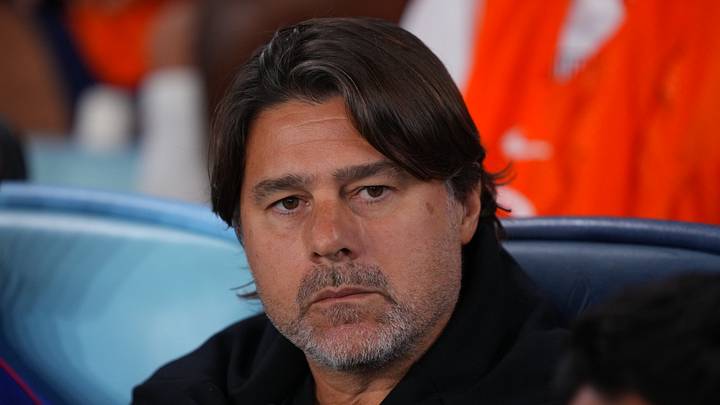
Former United States manager Mauricio Pochettino has swapped one United for another, having been named the new head coach of Manchester United.
He has taken over the role from Michael Carrick who was sacked, having been appointed manager in May after a successful interim stint.
It is a name that needs little introduction to anyone who has followed the Red Devils over the past decade.
Pochettino spent one season at Southampton in the Premier League before earning his big move to Tottenham Hotspur, where he remained for five years and guided the club to its first-ever Champions League final.
Following his departure from Spurs in 2019, just months after that final, Pochettino took charge of Paris Saint-Germain, a club he had previously represented as a player.
Across two seasons, he claimed his only major honours to date, winning the 2020-21 Coupe de France and the 2021-22 Ligue 1 title.
A one-year stint at Chelsea followed before the Argentine took on the role of United States manager, guiding the national side to the round of 16 at the expanded 2026 World Cup, which they co-hosted.
Now, Pochettino has joined Manchester United, with supporters hoping he can restore the club to the glory days of yesteryear.
Is Mauricio Pochettino the right man for the job?
It is a move a decade in the making.
During a meal shared between Sir Alex Ferguson and Pochettino in 2016, the Argentine was reportedly close to being offered the Manchester United job, had it not been for Avram Glazer.
With Louis van Gaal's reign coming to an end as the wheels of his defensive approach began to come off, United were actively searching for a replacement for the Dutchman. Sources at the club reportedly sensed that Pochettino was open to the move, with an apparent release clause in his contract potentially allowing United to bypass negotiations with Daniel Levy, whose reputation for driving a hard bargain was well established.
Glazer, however, opted for the tried-and-tested approach of appointing a proven heavyweight, with Jose Mourinho arriving at the club as news of his appointment emerged on the day Manchester United lifted the FA Cup in what proved to be van Gaal's final match in charge.
A decade on, Pochettino has finally arrived at Old Trafford in a full-circle moment. But the question firmly on the lips of every United fan—and practically anyone else who cares an iota about football—is whether he is the right man to lead the club forward.
The short answer: Maybe.
The long answer: No.
Pochettino most notably deployed a 4-2-3-1 formation during his time at Tottenham, with the use of athletic full-backs central to understanding how his teams operate. Both full-backs would push high up the pitch, while one of the holding midfielders—usually Victor Wanyama or Eric Dier—would drop back to join the defence.
The two wide midfielders would move infield, while the attacking midfielder dropped deeper alongside the remaining holding midfielder to create a box-shaped midfield. This allowed the full-backs to occupy the wide areas without sacrificing control in the centre of the pitch.
We saw a similar approach at PSG, with Achraf Hakimi and Nuno Mendes pushing forward, while two of Kylian Mbappe, Neymar, or Lionel Messi occupied more central attacking positions.
At United, a similar system could see Diogo Dalot and Patrick Dorgu providing the width, with Matheus Cunha and Bryan Mbeumo moving into central areas, while either Kobbie Mainoo or Carlos Baleba drops into the defensive line.
However, implementing this system with United's current personnel would present difficulties.
Bruno Fernandes would potentially be forced into a deeper midfield role, similar to the position he occupied under Ruben Amorim, which often took the finer parts of his game out of the equation. Meanwhile, Baleba and Mainoo may struggle to adapt to the defensive responsibilities required of them.
An alternative variation of the system could prove more beneficial. Dorgu would continue pushing high up the pitch, with his experience as a winger allowing him to occupy the left flank naturally. Rather than Mbeumo drifting inside, however, the Cameroonian would remain wide, while Dalot moved infield from right-back to form a back three.
That would allow Mainoo and Baleba to operate as a midfield pairing, with Cunha and Fernandes occupying the more advanced central positions.
A double pivot of Fernandes and Cunha could also prove highly beneficial for Benjamin Sesko, giving the Slovenian more opportunities to receive line-breaking passes in behind opposition defences.
In principle, Pochettino's attacking system could be a dream fit for a club with such a strong heritage of open-minded, fast-flowing and counter-attacking football.
Yet, we have been here before.
David Moyes, Van Gaal, Mourinho, Ole Gunnar Solskjaer, Ralf Rangnick, Erik ten Hag, Amorim, and lastly Carrick.
All of these managers had a differing play style to some degree, and whilst not all were playing the attacking football that leaves fans on their feet, they were heralded as the person to move United forward.
Simply changing the face of the person sitting in the dugout does not change the outcome.
United have become a broken-down car, with the club repeatedly swapping the driver and expecting it to become a Formula One champion.
The only way Manchester United will make meaningful progress is when the Glazers sell their shares, ending their tyrannical 21-year ownership, and Jim Ratcliffe, Omar Berrada and Jason Wilcox depart from the club.
United have been stripped down of their identity since 2005, with the decline accelerated by Ratcliffe’s minority ownership ruling.
Until there is change at the top, there will be no real change on the pitch.
 Add us as a preferred source on Google